- Call tracking as a feature of a virtual PBX
- How call tracking can help a communication strategy
- Static vs dynamic call tracking - Megacall PBX
- How calls are monitored in the Megacall PBX
- Reports and analytics in the virtual PBX
- Call tracking use cases
We can introduce call tracking as a feature integrated within a virtual PBX that makes it possible to give context to something as everyday as a phone call. It’s not just about answering the phone, it’s also about understanding what lies behind each conversation.
And when this tool is part of a PBX like Megacall’s, companies move from simply making commercial calls to turning each call into useful information for marketing and communication strategies.
That’s why today we want to focus on the call tracking function of Megacall’s virtual PBX and how it can help boost a business.
Call tracking as a feature of a virtual PBX
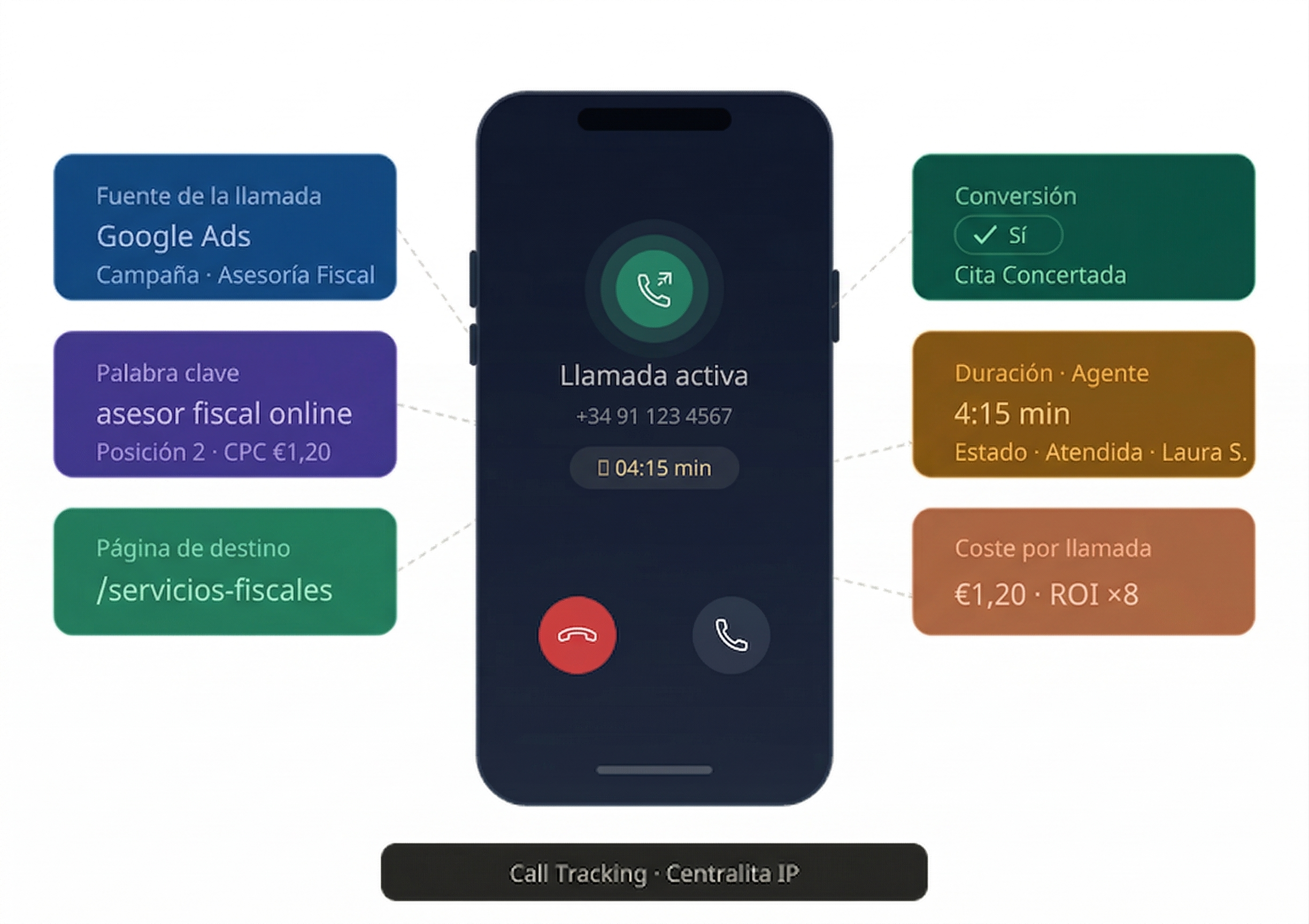
Call tracking is a feature that allows you to identify, record, and analyze phone calls with the aim of understanding their origin and measuring their impact within a business strategy.
Why did the customer call? Where from? And what happened afterward? These are questions that can be answered with this tool, and when integrated into telephony solutions, its advantages are even greater. From the PBX, calls can be redirected, organized, and handled with an added layer of intelligence that makes it possible to analyze each interaction.
This means that each call stops being a simple contact and becomes useful information:
- It can be associated with a specific campaign.
- It is automatically recorded within the system.
- Key information is obtained to improve the commercial strategy.
For call tracking to work, virtual phone numbers are used and assigned to each channel or campaign. For example, you can have a different number for Google ads, another for social media, and another for media advertising. This way, when someone calls one of those numbers, you can know where the call comes from.
The system also collects data such as how many calls have been received and how long they lasted. And if call tracking is connected to analytics tools, you go one step further: you can see the entire user journey, from when they enter your website to when they decide to call.
In other words, you not only know that someone has called you, but also the path that person followed on your website before picking up the phone.
How call tracking can help a communication strategy
The call tracking tool integrated within a virtual PBX provides significant value to any communication strategy.
Analytical capability
It provides something essential: data. From how long a call lasts, to which actions are generating contact with customers, conversion rates, and sources and channels. This helps better understand customer behavior and which campaigns are performing well. In the end, it’s not just about making calls, but also about being able to draw conclusions that help improve communication.
Facilitates real-time monitoring
Another advantage is that information is obtained almost instantly. This allows us to see how campaigns or phone support are performing without having to wait long. This means that if something is not delivering results, it can be corrected quickly.
Improves customer service
By having information about calls, it also becomes easier to improve service quality. For example, calls that are too short or too long can be identified, and the approach can be adjusted accordingly.
Helps capture potential customers
Each call is a sales opportunity, and call tracking helps make the most of them. By knowing which channels generate more contacts, it is possible to focus on those that attract customers who are genuinely interested. In addition, by better understanding the user journey before calling, messages can be more effectively personalized to attract higher-quality leads.
Another area where call tracking can help a business is in communication investment. In other words, by identifying the channels that generate more high-quality calls, companies can adjust their budget and focus on what really works, avoiding spending resources on ineffective actions and making better use of their investment.
Static vs dynamic call tracking - Megacall PBX
Within a virtual PBX like Megacall’s, call tracking can be applied in different ways. We distinguish between static and dynamic call tracking.
Static call tracking – Suitable for offline channels. This means the number remains fixed and is not replaced. Each source has its own assigned number, for example, a banner advertisement. In this way, when a call comes in, its origin can be easily identified because the tracker will detect how the customer reached you.
It is a simple and useful option for specific campaigns or when a very advanced level of detail is not required.
Dynamic call tracking – Suitable for online advertising. In this case, phone numbers change automatically depending on the user visiting the website. Each user is shown a different number, which allows for much more precise tracking of their behavior.
With this system, we can understand not only the channel, but also the user’s complete journey: from how they arrived at the website (through search, ads, etc.) to the moment they decide to call.
Within the Megacall platform, both types of call tracking are natively integrated, allowing the solution to be adapted to each company’s needs. It is also free to use, with companies only paying for the phone numbers used for a minimum period of 3 months.
How calls are monitored in the Megacall PBX
Imagine a user searches for the brand in a search engine and clicks on an ad. They are directed to a landing page where we have previously inserted a code that allows us to track their behavior.
At that moment, the visitor is assigned a phone number that identifies them throughout their entire interaction. Thanks to this, we can track their entire journey, from when they clicked on the ad to when they finally make the call.
From the personal area, you can set up all your projects by adding different trackers for each campaign, with customized configurations and their own statistics.
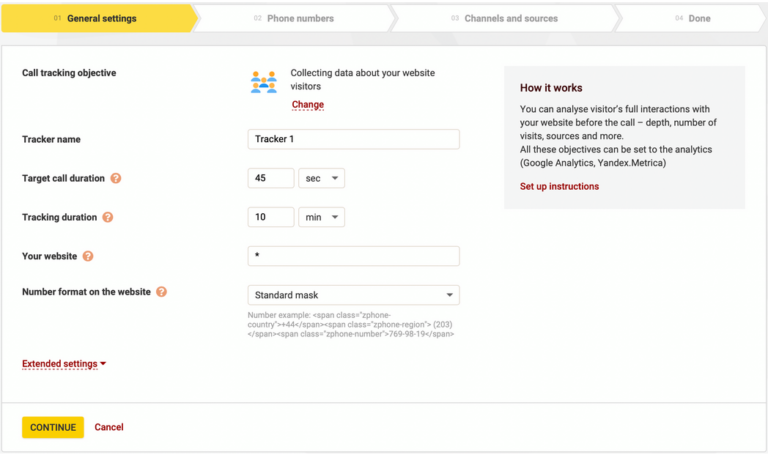
You can choose the tracker objective that best fits your needs, for example, to collect information, for online advertising, or for offline advertising. From there, you can carry out the entire configuration, which is presented in an intuitive way, and we also provide setup instructions so it can be completed step by step correctly.
We recommend using Megacall numbers and making the most of access to other platform features such as call recordings, CRM integration, and call analytics (among others), which serve as a very useful complement to the call tracking function.
It is also possible to integrate Megacall call tracking with Google Analytics, allowing for complete tracking of calls from the system.
Reports and analytics in the virtual PBX
Call tracking can be given even more value when combined with the reports and analytics of Megacall’s virtual PBX. Through the platform, you can access detailed reports that show truly useful metrics related to active campaigns.
For example, one of the most interesting features is the analysis of call transcriptions. With this, we can filter by specific words or terms to identify the most common customer questions, recurring patterns, or the type of information customers are seeking before making a decision.
Thanks to this type of analysis, we can detect behaviors and anticipate needs, adjusting both the messaging and the call tracking campaigns themselves. It can even help improve customer service scripts.
Call tracking use cases
Depending on the type of business and strategy, it may be more useful to use static or dynamic call tracking. Below, we will see 3 brief examples showing its usefulness in each case.
Local services with multichannel campaigns
Businesses such as clinics or workshops often work with different channels: offline advertising, social media, Google Ads, etc. In this case, static call tracking allows them to easily identify where each call comes from.
They may discover that most calls come from Google searches rather than social media. With this information, they can adjust their investment and focus on the channels that truly generate contacts.
E-commerce with strong online presence
These are businesses that may require a more advanced level of tracking. With dynamic call tracking, they can know which channel each call comes from and also what the user did before calling: which product interests them or at what stage of the contact process they are.
These types of campaigns are key for optimizing the user experience and detecting friction points in the conversion process.
Real estate sector with a conversion focus
In sectors like real estate, which have a strong focus on conversion, every call is a very important business opportunity.
Here, the ideal approach would be to combine both models (static and dynamic), creating a different tracker for each. On one hand, the static call tracker measures the performance of specific campaigns or actions. On the other hand, dynamic tracking analyzes user behavior in depth when they reach the website.
In these sectors, every call has significant value. Losing a call in e-commerce is not the same as losing one in real estate, where thousands of euros may be at stake. Therefore, it is not enough to generate contacts: they must be used effectively.
By analyzing calls, it is possible to detect things such as:
- What type of leads are calling.
- How long calls that result in a sale last compared to those that don’t.
- What questions or doubts repeat before closing a deal.