
AI calls vs. human agents: Advantages, limitations, and when to use each
July 9, 2026
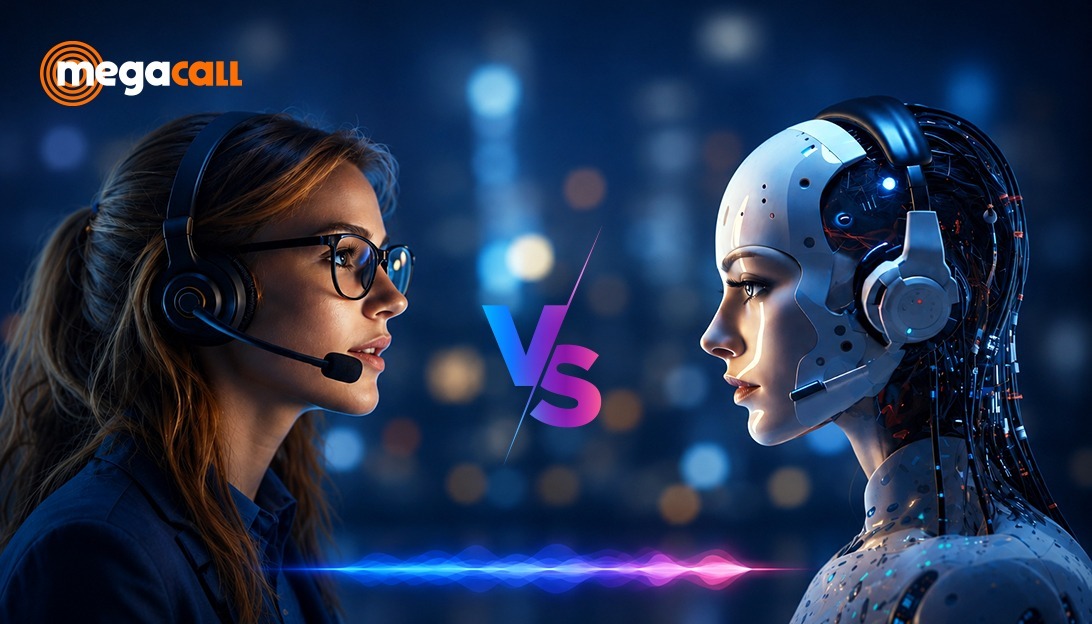
If you manage calls in your business, you know it’s not just about answering the phone. You need to respond quickly, maintain consistent service, avoid losing opportunities along the way, and still preserve a human touch. And all of this while call volume grows or spikes at specific times.
That’s why it’s natural to start looking for an option that helps take some of that workload off your plate. More and more companies are relying on artificial intelligence to automate calls. So, in which cases does it make sense, and when is it still better to have a person on the other end? That’s exactly what we’ll explore in this article.
Advantages of human agents in calls
No matter how advanced an AI voice agent may be, there is still territory that remains exclusively human—and that is emotional intelligence:
- Handling real frustration. When a customer is upset, they want to speak to a person who can resolve the issue immediately. Although AI can detect a customer’s tone, in these cases it’s better for a human to manage the call, calm them down, and solve the problem without intermediaries.
- Reading between the lines. A human agent can pick up on what isn’t being said, better understand the situation, and anticipate problems.
- Building long-term relationships with key clients. All customers are important, but there are always those who have been with the company for a long time and may require a more personal approach.
- Complex negotiations. When persuasion, negotiating terms, or delivering a sales pitch on the spot is required, human flexibility still stands out.
- Genuine spontaneity. It may seem like a small detail, but it’s quite relevant in a conversation. The ability to improvise remains a uniquely human trait.
Limitations of human agents in Calls
Human voices bring empathy to a conversation, but they also have limitations if they are the only resource used to handle calls:
- Difficulty scaling. It’s not easy to grow a team overnight, especially since it requires hiring more staff (more cost) and training, which takes time.
- For obvious reasons, they won’t have the same full availability that an AI agent can offer at any time of day.
- Capacity is limited. During peak call times, queues begin to form, wait times increase, and call abandonment rises.
Advantages of AI Calls
For modern support that takes care of repetitive but essential tasks, the best option is to rely on artificial intelligence. Integrating AI doesn’t fully replace humans, but it significantly improves operations through automation. That’s why its biggest advantages are:
- Full availability. AI agents operate continuously, 24/7, all year round if needed.
- Multilingual support. Thanks to natural language processing, an AI voice agent can handle calls and interact fluently in different languages—one of the greatest advantages for reaching international markets.
- Reduces workload from simple and repetitive tasks. Tasks such as data validation, status inquiries, frequently asked questions, business hours, etc., can be perfectly handled by an AI agent, leaving more complex cases that require judgment and empathy to human operators.
- Unlimited scalability. If the business grows, an AI system can handle a large volume of simultaneous calls without the need to increase human resources, which also means saving on hiring additional staff.
Limitations of AI Calls
Although AI call automation offers unmatched performance in terms of volume and availability, it also has its limitations:
- Limited customer empathy. While it’s true that AI can simulate politeness and even detect a user’s tone of voice, it does not have real empathy. This means that although it can respond correctly, it cannot genuinely engage with customer emotions—especially in situations where the user is upset.
- Rigidity in unexpected situations. If a conversation goes off script or falls outside its training (the information provided when creating the agent), it may become confused or provide generic responses.
Quick comparison table
|
Criteria |
AI Agent |
Human Agent |
|
Availability |
Full 24/7 |
Limited to the agent’s schedule and shift |
|
Emotion management |
Low |
High |
|
Flexibility in complex cases |
Limited |
High |
|
Response speed |
Immediate |
Depends on agent availability |
|
Cost |
From €0.07/min* |
Requires hiring more staff |
|
Ideal use cases |
FAQs, inquiries, business hours, call routing |
Closing deals, handling complications, escalations |
|
Scalability |
Can handle many calls simultaneously |
Limited by the number of agents |
|
Flexibility |
Responses based on predefined information |
High capacity for improvisation |
|
Multilingual support |
High ability to communicate in multiple languages |
Limited by the agent’s language skills |
*At Megacall, AI-powered calls start at around €0.07/min, depending on the artificial intelligence model selected.
The model that works best in practice
Experience shows that there’s nothing better than a human agent who can assist us with the empathy and understanding that AI still cannot fully replicate. At the same time, people value having quick answers—especially for simple inquiries—and that’s something a human agent can’t always provide, since they may already be on another call, busy, or simply short on time.
That’s why the best approach is a combination of both, where one covers for the other when unavailable, ensuring complete and continuous service at all times. In other words, incorporating AI-handled calls into your system is the most effective way to cover all bases.
For example, a very common and effective setup looks like this:
- AI handles the call, identifies the intent, and resolves what it can directly (such as providing information like business hours, scheduling appointments, or managing reservations).
- If it detects ambiguity, frustration, or something beyond its capabilities, it transfers the call to a human agent.
- The human team can then focus on more complex cases with more available time, since they are no longer overwhelmed by routine inquiries.
How to know if your company needs an AI Voice Agent
You may already have human agents handling your business calls, but have you evaluated whether workload, response times, and service quality are aligned with your company’s expectations?
A clear sign that your business could benefit from AI-handled calls is team saturation. If your operators struggle to keep up during peak demand, it may be time to consider a virtual agent to help manage those calls.
It’s also worth considering if a large portion of your inquiries consists of basic information, confirmations, or simple processes. Below, you’ll find a table outlining different scenarios and how AI can help, giving you a clearer idea of whether your business needs a virtual voice agent.
|
Situation |
How AI helps |
|
High call volume |
Can handle multiple calls simultaneously and reduce wait times |
|
Repetitive inquiries |
Handles repetitive queries to reduce workload for human agents |
|
Customers in different languages |
Responds in the specified language without needing to hire multilingual staff |
|
Overloaded team |
Reduces the workload on operators |
|
Need to professionalize phone support |
Automates calls and ensures professional customer communication |
|
Need to prioritize calls |
Routes calls to the appropriate department when necessary |
|
Need for after-hours support |
Responds outside business hours and at any time of day |
How to implement AI for your business calls
Today, there are countless solutions available to adopt AI-powered calls, but the key is to consider factors such as complexity, how quickly it can be implemented, and of course, cost.
To get started with AI-powered calls, the main requirement is having a virtual number that you will use to make and receive business calls, which will then be connected to a phone system.
The most cost-effective option is to choose a phone system like Megacall. If you already have a number, you can keep it; if not, you can select one from their catalog—numbers from more than 100 countries are available. For example, a Spanish number starts at around €2/month with annual billing.
Once your number is connected to the system, creating your AI voice agent is a quick process, as everything is managed within the Megacall platform itself—no need to leave the platform or install anything additional. You can customize the agent according to your needs, define its personality based on the department, and even choose the voice that best fits.
Additionally, as a bonus, the phone system allows you to add extensions for human agents alongside AI, enabling a hybrid model from a single platform.
FAQs— AI Calls
What happens if the AI doesn’t know how to respond?
It is recommended that the system is prepared to escalate the call to a human agent or redirect it appropriately. In the case of the Megacall phone system, you can configure these transfers and routing rules to ensure the customer receives the right response.
What level of personalization can an AI voice agent have?
Today, the level of personalization for an AI agent is high. You can define its tone, communication style, speech speed, whether it sounds more natural or follows stricter boundaries, the language, and even the option to handle a second language.
How long does it take to implement an AI voice agent?
It depends on the provider, as some require more technical knowledge. However, with platforms that already have it integrated into their phone system, you can have an AI agent up and running in just a few minutes.
How is an AI voice agent trained for calls?
It is configured based on conversation flows and company-specific data. In other words, you define how it should respond in each situation and provide it with a knowledge base containing relevant information. The more complete and specific this base is, the better its responses will be and the more natural the interaction.
Can calls be analyzed to improve the business?
Yes, this is one of the biggest advantages of having a virtual phone system. Calls are recorded, and with features such as recording, recognition, and transcription, each interaction can be analyzed to identify improvements or even sales opportunities.
You may also like…


The 400 prefix and the new regulation for commercial calls
September 28, 2026

Call whispering: the discreet support that improves calls
September 14, 2026