
900 number for businesses: how much it costs, how it works and when a landline is a better option
August 28, 2026

You’ve probably heard more than once that calls to 900 numbers are free. Yes, 900 calls are free, but not for you — they’re free for the caller. Before getting a 900 number for your business, it’s worth understanding exactly what you’re paying for and whether you actually need it, because in many cases a standard landline number can do the same job for less money.
What is a 900 number and how does it work?
A 900 number is a reverse-charge number. This means the call is free for the person making it. The customer dials the number, speaks with the company, and does not see any charge on their bill, whether they call from a landline or a mobile — that cost is covered by the company.
The way it works is simple: the call is handled like any other, but as mentioned, the cost is not paid by the caller, but by the company receiving the call. That cost is calculated based on the duration of the call and the type of origin (for example, whether it comes from a mobile or a landline), and it is billed to the company that owns the number.
That’s why it is widely used by utility companies, insurance providers or large service companies, as it removes the barrier for customers who might otherwise avoid calling due to cost.
So, how much does a 900 number actually cost?
The cost a company pays for this type of number depends on the provider and whether calls are made from a mobile or a landline. To understand the cost of a 900 number, we can break it down into two parts:
- First, there is a fee for keeping the number active, meaning a monthly subscription to be able to use the number. This depends on the provider you choose. As an example, at Megacall a 900 number for Spain costs €2 connection fee plus €2 per month when billed annually.
- The per-minute cost for each incoming call is where the monthly bill really adds up. It is not the same if a customer calls from a landline or from a mobile. Calls from mobile phones are always more expensive for the party paying, and with a 900 number that cost is covered by the company. In the case of Megacall, incoming calls to 900 numbers cost €0.02 from landlines and €0.14 from mobile phones.
To see a clear example of the cost of a 900 number:
Imagine a month with a volume of 300 received calls, an average call duration of 3 minutes, which results in around 900 minutes of incoming calls per month. Let’s assume that 80% come from mobile calls and 20% from landlines, this would be:
- 720 minutes from mobile → 720 × €0.14 = €100.80
- 180 minutes from landline → 180 × €0.02 = €3.60
This would total around €104.40 for that month alone, without taking into account the monthly fee for the number.
In short, most of the bill comes from mobile calls, especially considering that today users almost always call from mobile devices. This is the calculation you need to make based on your real call volume before deciding whether to get a 900 number, as the actual cost can end up being much higher than you might expect.
900 or geographic landline: how to decide
There is no single right answer. It all depends on your target audience and how many calls you handle.
A 900 number is a good fit if:
- You have a large customer base in the country and want to remove any friction that could prevent people from calling you.
- You operate in a competitive industry where a large-company image matters, and a 900 number can reinforce that perception.
- Your call volume is manageable and the per-minute cost does not eat into your profit margins.
- You are in a regulated sector where the law requires a free customer service line.
A geographic number is a better fit if:
- You want to convey proximity and trust with a local number, in any country.
- You are a small business or freelancer and your call volume does not justify the cost of a 900 number.
- You do not want costs accumulating with every incoming call.
- You handle a high volume of calls and want to manage them without incurring significant expenses.
Case 1
You run a local business: a neighbourhood clinic, workshop or physical shop. Your customers already know where you are and will most likely call you from the same city. A geographic landline with your area code (91, 93, 95...) conveys closeness, not distance. A 900 number here does not add anything the customer values, and it does add an unnecessary cost. A landline with a local prefix is cheaper for the caller and does not change the client's calling experience at all.
And to be blunt, many SMEs DO NOT need a 900 number. If most of your customers are local, already trust you, or you simply don’t want extra costs on your bill, paying for a 900 number doesn’t make much sense. A 900 only makes sense when the call volume justifies the cost.
Case 2
You sell online across Spain and want to make it easier for people to call you. If your customer could be in Vigo or Almería and has no prior relationship with your business, a 900 removes the last excuse not to call: “it won’t cost me anything.” In this case, it can make sense if you are a large company and the cost of incoming calls is justified by the revenue and does not generate losses. The same result can also be achieved with geographic numbers, where the company does not pay for incoming calls.
What about the 800 number?
The 800 works exactly the same way as the 900: free for the caller and paid by the company, with the same purpose. The difference is that the 900 has been on the market longer, so users recognise it more easily as a free customer service number compared to an 800. The 800 may therefore create slightly more hesitation before calling.
If you still have a 902 number
Having a 902 number can be more of a problem than an advantage. With a 902, the full cost is paid by the caller (the customer), and from a branding perspective it sends the opposite message of what companies usually want: it feels expensive, like a barrier, and not very transparent — and no customer wants that.
Our recommendation is to move from a 902 to a 900 or a geographic landline, where each party pays what they are supposed to pay. In most cases, this is far more cost-effective than keeping a 902 number.
What about 400 numbers?
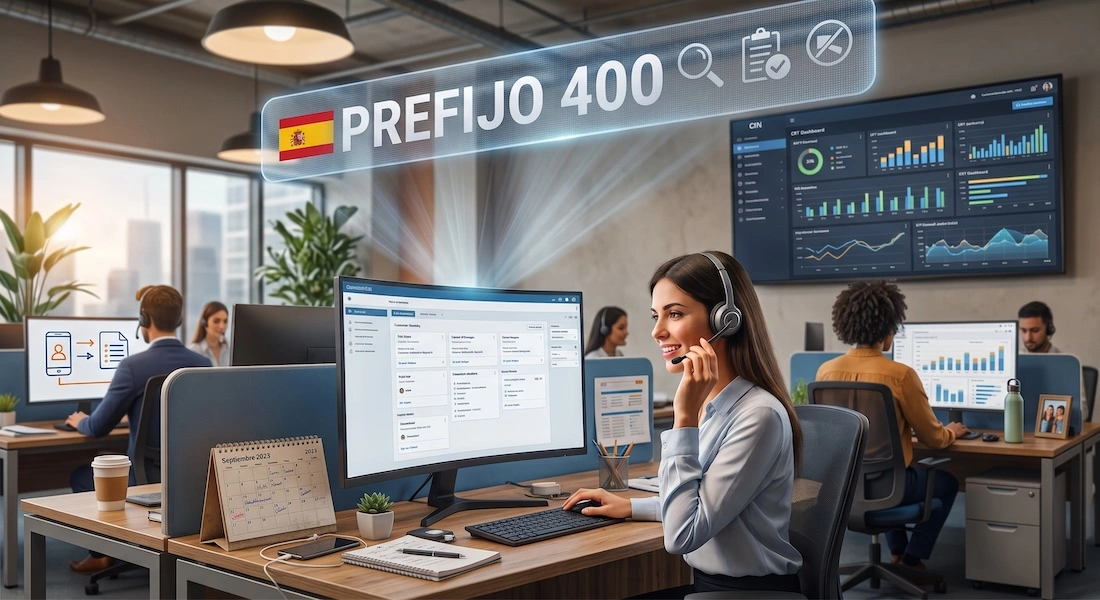
Here it is important to clarify something: a 400 number does not replace your 900 number.
A 900 number is used to receive calls.
A 400 number is exclusively for making outbound commercial calls, and it is one-way: you cannot call back that number. It is a measure designed so that users can immediately recognise that they are receiving a sales or commercial call.
From 17 October 2026, commercial calls will have to be made from a number with the 400 prefix.
However, this requirement applies only to outbound commercial activity (telemarketing, sales campaigns), and mainly to large companies and providers of essential public services. It is not a rule that affects every SME simply for having a customer service phone line. If in doubt, it is best to check whether your company falls under the scope of Law 10/2025.
In any case, there is no need to replace your 900 with a 400. They serve different purposes: the 900 remains your customer service number, while the 400 (if applicable) is only used for commercial or sales calls.
Example:
Imagine an insurance company running phone-based acquisition campaigns. Its sales team calls potential customers every day to offer policies. In the past, these calls could be made from standard landline numbers. Now, they will use the designated 400 number so that the customer immediately recognises it as a commercial call. Meanwhile, customer service enquiries would still be handled through a geographic number or a 900 number.
How to get a 900 number with Megacall
Whether you are setting up a 900 number or a geographic landline, the process is the same.
- Sign up on the Megacall platform
- Choose your number: Here you will find 900 numbers and geographic numbers from more than 100 countries.
- Top up your account so you can make calls.
- Connect it to the virtual PBX to access all the benefits of a virtual number.
In addition, 400 numbering will soon be added to the Megacall PBX so you can continue making commercial calls without interruptions.
Frequently asked questions
Can I port my current 900 number?
Yes. If you already have a 900 number with another provider, you can keep it and transfer it to Megacall. The process is similar to any number porting: you do not lose your number, and your customers will not notice the change.
Can I receive multiple calls at the same time?
Yes. You are not limited to a single call like with a traditional line. You can handle several simultaneous calls without them interrupting each other, and distribute them across your team automatically or manually depending on how your PBX is configured. For example, if a call comes in and your agent is busy, the system can route it to the next available agent or place it in a queue with hold music or a waiting message until someone is free to answer it.
Does it work with a virtual PBX?
Yes. In fact, this is the most common setup. The 900 number integrates with the virtual PBX just like any other number: you can configure greetings, schedules, call forwarding, queues, or integrate it with your CRM.
Can I have both a 900 and a landline number at the same time?
Yes. You can use the 900 number for general customer service and keep a landline number for support, local contact, or regular customers.
You may also like…

The 400 prefix and the new regulation for commercial calls
September 28, 2026

Call whispering: the discreet support that improves calls
September 14, 2026