

We have a new team, and at the beginning it’s normal to have certain “insecurities” about whether they will manage a customer conversation properly. And from experience, we know that even when there is prior training and a script, there are often moments when you have to step outside of what was planned — in fact, it’s normal — and in that moment, a small real-time support can be very useful.
For this, we use whisper mode in a PBX system, also known as call whispering. With this feature, we can help the agent or provide information so they can continue the conversation without the customer noticing.
What exactly is whisper mode?
Call whispering is a feature of a VoIP telephony system that allows a supervisor to join an ongoing call between an agent and a customer, and speak directly to the agent without the customer hearing a single word of the parallel conversation.
In other words: as a supervisor, you can “enter” your agent’s call and say things like “ask for the order number,” “offer tariff A, not B,” or even give encouragement to an agent who is on their first call and feeling nervous.
It is not the same as reviewing a call afterward — although that is also useful — because the key point is that it allows action in real time. When you listen to a recorded call, you can detect mistakes that have already happened and improve them for the next one or correct an employee’s way of working. With whisper mode, support arrives before any mistake can be made.
Why can call whispering improve the way a team is managed?
Those who have worked in customer service know how important it is to make decisions within just a few seconds, and that after that there is very little room to correct them. Features like call whispering are very helpful in making what is said at each moment more accurate, and in giving the agent support exactly when they need it. And the way it helps is:
Real training instead of theoretical training.We could say this is the main benefit of this feature. The training given to the agent is real, not just theoretical through scripts or by listening to recorded calls. It is much more practical. The agent starts handling calls from the beginning, but with a supervisor who can guide them live.
It avoids mistakes at key moments.From experience, we know that in a sales or customer service call there are moments or decisions that can completely change the outcome. For example, having to respond to a rejection or when pricing needs to be mentioned. We must always keep in mind that there are situations in which there are no second chances in this field, so the fewer mistakes we make, the better.
Handling difficult customers without escalating the issue.If the supervisor is on the call at the exact moment when the situation becomes difficult, they can give instructions to the agent on how to continue the conversation without having to escalate it to another manager. Even, if necessary, the supervisor can intervene in the call.
Supervision without pressure.Finally, although it may sound redundant, there is supervision itself. And this does not necessarily mean pressure. If supervision is handled properly, meaning that the agent is informed of the process throughout the call, it does not have to feel like pressure, but rather support.
Important detail about call whispering
One important detail to keep in mind is that, depending on the provider and certain configurations, call whispering may not be available. In the case of Megacall, it would not be compatible when calls are routed through call forwarding. This does not affect normal usage; it is just something to consider when configuring call flows.
An example of how it can work in practice
Let’s think of a typical call center case:
The team manager is assigned as call supervisor to monitor how the new agent handles a campaign with a customer.
At first, they decide to enter listen-only mode (just listening, without intervening) to check that everything is going correctly. However, at one point, they notice that the agent is incorrectly explaining a condition of the offer. Instead of waiting for the call to end to correct it — by which point the customer will already have the wrong understanding — they activate whisper mode and tell the agent that the promotion applies only for the first month, so they can clarify it before the customer hangs up.
This way, the agent clarifies the point about the offer before ending the conversation, and the customer never realizes that moments earlier there was an intervention to correct the information.
How to use call whispering in a PBX system
Call whispering is part of the PBX system, and a user with that role can typically access calls and decide how to interact:
- Listen to the call. This is what we referred to as “listen mode,” where the supervisor joins as a silent listener. Neither the agent nor the customer notices they are on the call. It is mainly used to evaluate service quality.
- Whisper mode. The supervisor listens to the call and can also speak to the agent, but the customer remains completely unaware.
- Conversation mode. Here, the supervisor becomes part of the call, being able to speak both with the agent and the customer, like a three-way call. It is used when the situation requires the manager to take control.
To use whisper mode in Megacall’s PBX, you only need to assign a supervisor role to an extension:
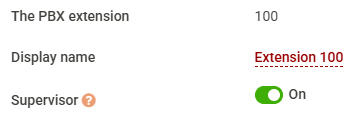
To join a call:
- Dial code 007.
- After the automated response, dial the employee’s extension number.
- Select one of the modes:
- Button 4: listen mode.
- Button 5: whispering mode.
- Button 6: conversation mode.
The supervisor is automatically connected to the ongoing call. Within the conversation, you can also switch between supervisor modes.
FAQs - Whisper mode
How much does the call whispering feature cost?
Call whispering has no additional cost in Megacall’s PBX system. It is an included feature, and you only need to configure the corresponding permission in the PBX. The only requirement is to have an active number, starting from €2/month with annual billing, and a balance top-up every 3 months.
How can you get the most out of call whispering?
This feature reaches its full potential when combined with other functionalities such as call recording, which allows you to review afterward how the conversation was handled. It can also be combined with analytics to identify which types of calls generate more issues, where opportunities are being lost, or where the team needs more support.
Does the customer know if I’m using whisper mode?
No, the customer does not know that whisper mode is being used. From their perspective, the call is completely normal and they are only speaking with the agent. The supervisor’s communication goes only to the agent, unless the supervisor decides to join the conversation with the customer. However, this is optional; in most cases, the customer only speaks with the agent.
Can whisper mode be used on any call?
Not always. For call whispering to work correctly, the call must pass directly through the PBX so that it can be controlled. This means that if the incoming call is routed through call forwarding, whisper mode cannot be used in that conversation.
You may also like…

The 400 prefix and the new regulation for commercial calls
September 28, 2026
Call whispering: the discreet support that improves calls
September 14, 2026