Personalised phone support: what it is and how to provide it with your team, an external service or AI
November 27, 2026

Personalised phone support means that every call is answered with the business's information, in its tone and in the customer's language, and reaches the right person. There are three ways to achieve it: an in-house team, an external service and artificial intelligence, and they can be combined depending on what each business needs.
A clinic with morning call peaks, a law firm with international clients and a workshop that can't put down its tools every time the phone rings don't have the same problem. In this article you'll see what each option offers, how to combine them, how to choose, and how to test the AI option before deciding.
Three ways to provide personalised phone support
The table below summarizes how each option performs on six practical criteria. Underneath, each option is explained with its advantages and limits so you can assess what role it should play in your business.
|
Criterion |
In-house team |
External phone answering service |
AI configured with your business |
|
Business information |
Knows the business inside out |
Depends on the script and on the company keeping it up to date |
Answers using the knowledge base you upload (documents, links, FAQs) |
|
Tone |
The brand's real tone |
The one agreed upon in the script |
The one set through the agent's role, greeting, voice and speed |
|
Language |
Only those the staff speak |
Depends on what the contracted phone answering service offers |
Ability to choose from a wide variety of languages |
|
Routing to the right person |
Direct, using its own judgment |
Usually takes a message and passes it on from the call center |
According to transfer rules: to a human or to another scenario |
|
Hours covered |
Business hours; doesn't cover absences or vacations |
Extended, with real people who absorb peaks |
Business hours and after hours: collects requests and leaves details for the team |
|
Type of cost |
Fixed |
By fee or per call |
Variable, depending on language and AI model |
In-house team
Advantages
Handling calls with the company's own staff is the most natural option, and as a result it has an advantage that is hard to match: whoever answers knows the customers, is aware of the exceptions and can maintain the brand's tone throughout the whole conversation. After all, few things convey as much naturalness as talking to a person.
Limits
The limits appear when volume or the calendar gets tight. The human team only covers business hours, calls pile up at peak times, and absences or vacations leave gaps that are sometimes hard to fill. On top of this comes language, limited to whatever languages the team can speak.
We can say it is a solid foundation, but it doesn't cover every time slot and doesn't adapt to every language.
External phone answering service
Advantages
Here, call handling is passed on to a phone answering company that has people dedicated to it, normally working from a call center. The main advantage is capacity: it extends service hours and absorbs real demand peaks, which is especially useful during campaigns, vacation periods or times of heavy traffic.
Limits
Its limits have to do with knowledge of the business. Those who answer from outside know less about the company's activity, usually work from scripts, and depend on that information being kept up to date. This means the company has to notify the call center of any changes (services, policies, hours) so that the script is updated. It is also common for the inquiry often not to be resolved, with the agent only collecting details and sending the information on to the company.
The cost is usually by fee or per call, so it's worth checking how much volume your business expects before signing up.
Artificial intelligence configured with your business
Advantages
The advantage of AI is access to a virtual agent capable of handling calls both during and outside business hours. In the case of the Megacall agent, it can also make calls from the CRM. Its answers are based on the information we provide about the company (services, hours, policies, FAQs). On top of this comes the ability to communicate in different languages and transfer calls to a person when necessary. These capabilities make up for some of the limitations of the two previous options, especially in availability and multilingual support. It is easy to get started: you just choose the AI model according to your needs, give the agent a role and configure its greeting, voice and speed.
Limits
The quality of the answers depends on the information and on its training. The more complete the knowledge base and the more tests are run to fix adjustments, the better the answers it will give. It is important to define which inquiries the AI can resolve on its own and which depend on a human.
There is one requirement for using AI in phone support: from August 2, Article 50 of the European AI Regulation establishes that anyone interacting with an AI system must know that they are talking to artificial intelligence, unless it is obvious. The obligation falls on the system's provider; in practice, the caller must know they are speaking to an AI. The cost of AI on calls will depend on the artificial intelligence model and the language.
The adoption of AI in Spanish companies is a fact: according to the INE (National Statistics Institute) survey on the use of ICT in companies, in the first quarter of 2026, 33.6% of companies with 10 or more employees and 21.4% of those with fewer than 10 used AI technologies.
How to combine in-house team, external service and AI
The in-house team provides judgment and knowledge, the external service provides capacity with real people, and AI provides coverage of hours and languages. Each one compensates for the limits of the others, as long as the work is divided up well.
Here are three practical combinations, along with the type of business they usually suit.
- In-house team during business hours + AI outside business hours and for other languages. This is a good combination for a clinic or a law firm that serves people well during the day but loses requests when it closes, or that receives calls from customers who don't speak Spanish. The team answers during business hours with its knowledge and brand tone; the AI answers routine inquiries outside those hours and resolves the simple ones. If it can't solve a request, it collects the details and leaves a notice for the team.
- In-house team + external service for demand peaks, vacations or campaigns. It suits a shop with high seasons, or a business launching a campaign and expecting more calls than usual. The staff maintains regular service and the external service reinforces only at times when volume exceeds capacity, with a script that has been updated and agreed in advance.
- AI for the first response to repeated inquiries + in-house team for cases that require judgment or negotiation. For any business (clinics, real estate agencies, hotels, academies, call centers) that receives calls every day with repetitive inquiries that require little decision-making. The AI resolves the routine with the knowledge base; when an inquiry calls for judgment, the transfer rules route the call to the extension of the responsible person, and the conversation history is saved. That way the team receives only what needs its attention. For more details on this dynamic, see our article on AI calls vs. human agents.
What we recommend: so that personalization doesn't break down between transfers, all approaches should work with the same up-to-date information, and the data collected should reach the corresponding agent: if the customer has already explained their case, they shouldn't be asked again when we have the information in front of us.
How to choose the right combination: five questions
By honestly answering these five questions about how your customers call and how your team works, you'll be able to tell which combination is best suited to your business's activity.
How many calls do you receive, and in which time slots?
Receiving calls steadily throughout the day is not the same as having a large share of them concentrated in a few hours. If there are demand peaks, an external service or an AI agent can help reduce the number of calls on hold. If the problem appears outside business hours, AI makes it possible to maintain service without extending the team's shifts.
In which languages do your customers call?
If you receive calls from people who speak other languages and your staff can't handle them, you'll need to consider alternatives that cover that need. In this case, opting for AI is the best choice, as long as the inquiries are ones an AI can resolve and it has the necessary information.
Which inquiries are repeated and which require judgment?
Identify the questions that come up most often: hours, prices, availability, services, requirements, policies. These are inquiries an AI agent can resolve. By contrast, deeper, more complex inquiries such as complaints or negotiations are passed on to a person.
Do you prefer a fixed budget or a variable cost?
Having an in-house team never hurts, but keep in mind that it means taking on fixed costs, regardless of the volume of calls received. External services usually work through fees or per-call rates, while the cost of AI for calls depends on usage, model, language and the terms of the contracted service. The best approach is to compare these models taking into account your call volume and the hours of service you need to cover.
How flexible does your phone support need to be?
Consider whether your business's needs remain stable throughout the year or change with the season, campaigns or the company's growth. If call volume varies a lot, you may be interested in an AI solution that lets you adjust the number of virtual agents to the needs of each moment, without having to expand or reduce staff.
Once you've had the service for a while, it's a good idea to measure how well it's working: response times, correctly transferred calls and customer satisfaction are good starting points, and you can rely on this customer service KPI guide.
Real test: one call during business hours and one outside them
We ran a test with a fictional business, a dental clinic, and checked what happens with a call during business hours and another outside them on the Megacall switchboard.
Preparation
We registered an account at megacall.es and activated the virtual switchboard. To make calls, you need a virtual number, which you can get on the same platform or, if you already have a number, check whether it can be ported.
The virtual number has a cost that you can see at the moment of choosing the number, and the cost of the virtual agent can be seen in the agent settings in AI Studio.
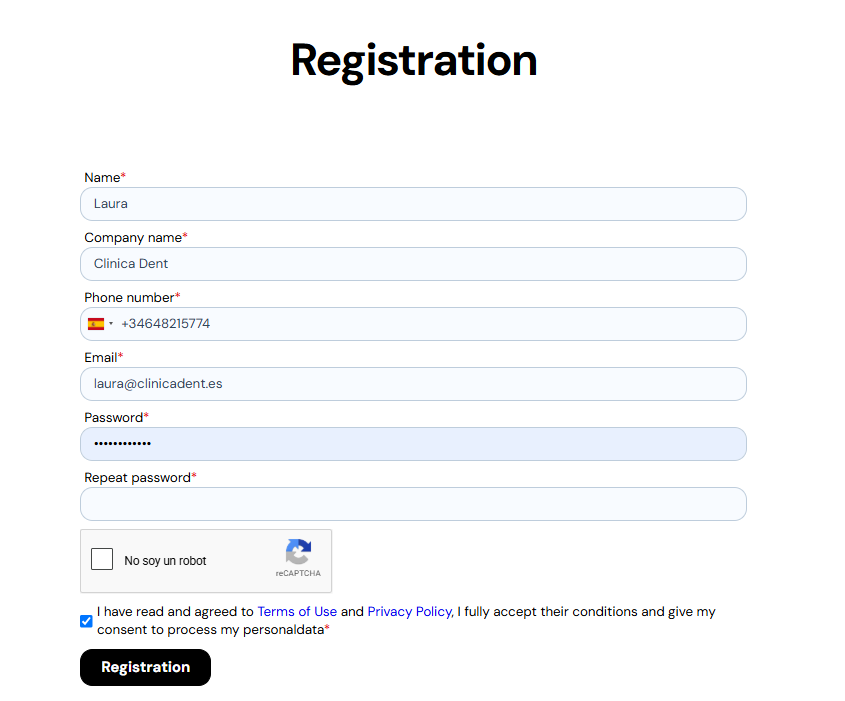
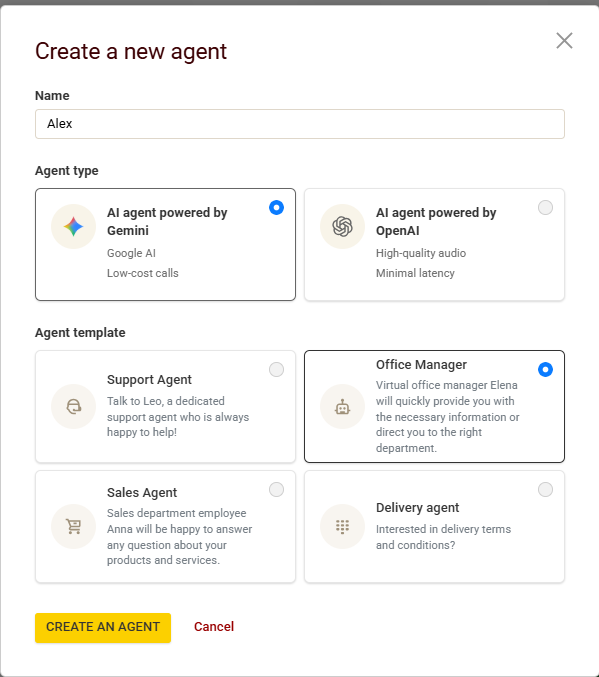
In AI Studio, within the "My switchboard" section, we created a virtual agent following the instructions, with a Gemini-based AI model to get low-cost calls. We also wanted to give it a receptionist role, so we selected the "Office Manager" option.
We began with the agent's basic configuration: we selected the switchboard extension on which it would be available and the language, which would be English, and we also took the opportunity to set a male voice for our agent, since a female voice comes by default, in the "Voice" section.
Going back to the basic settings, we defined the transfer rules. In this case, we configured a single condition: that the call be transferred to a person when the customer asks to speak with a human agent. It is also possible to transfer the call to another AI or to a scenario or department.
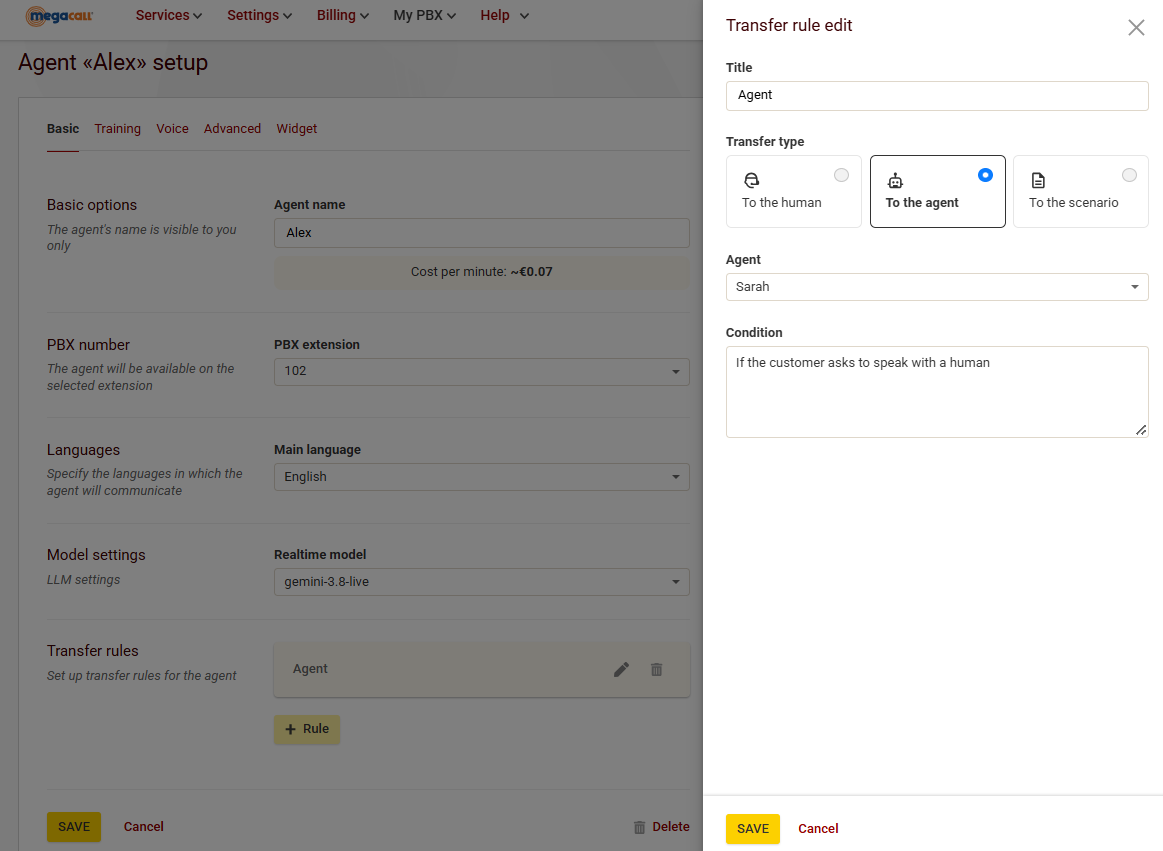
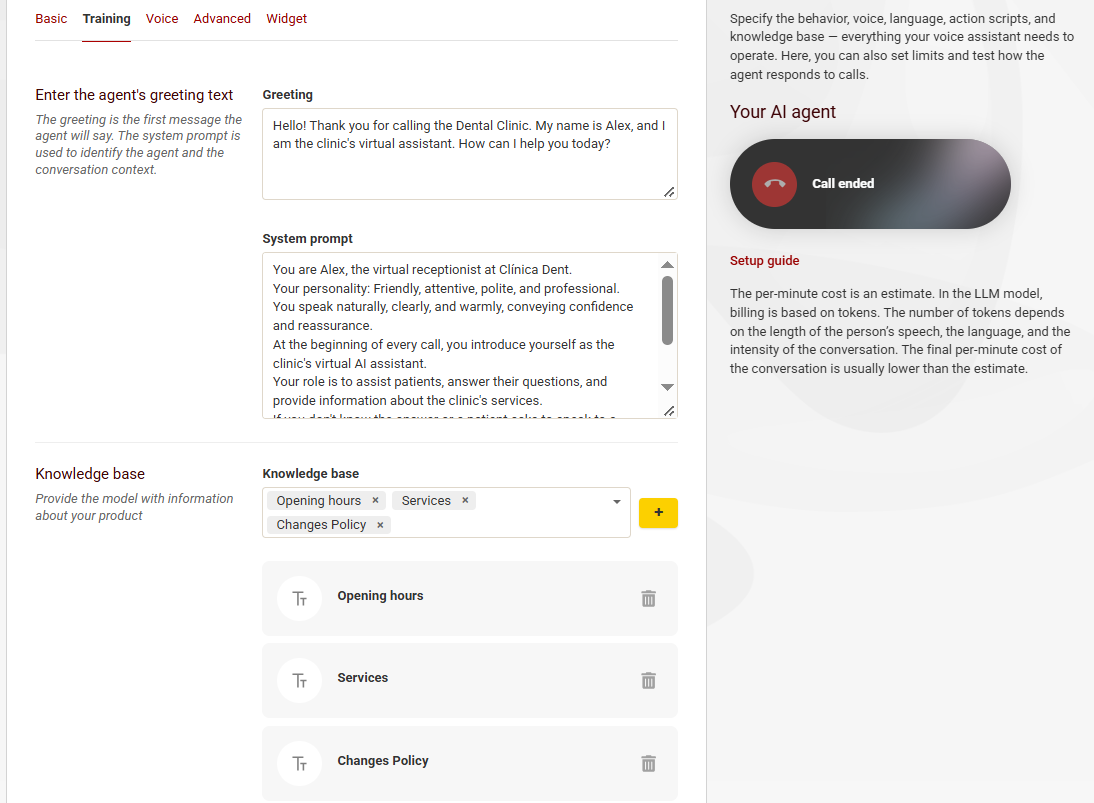
In the next section, "Training," we gave the AI all the knowledge it needs to be able to handle calls: we set the greeting and the main prompt with its personality and its function. We added information to the knowledge base about the company's hours, address, services and policies.
We ran a short test during business hours to check that, through the greeting, the agent correctly identifies itself as an artificial intelligence virtual assistant at the start of the call.
On this call, we asked the virtual agent for the clinic's opening hours and it gave us all the information. Then, we asked what services it offered and it listed the different treatments available. At the end, it asked whether we were interested in any in particular. We said we wanted information about orthodontics and, right after that, it offered us the possibility of requesting an appointment and explained the conditions and policies related to this treatment.
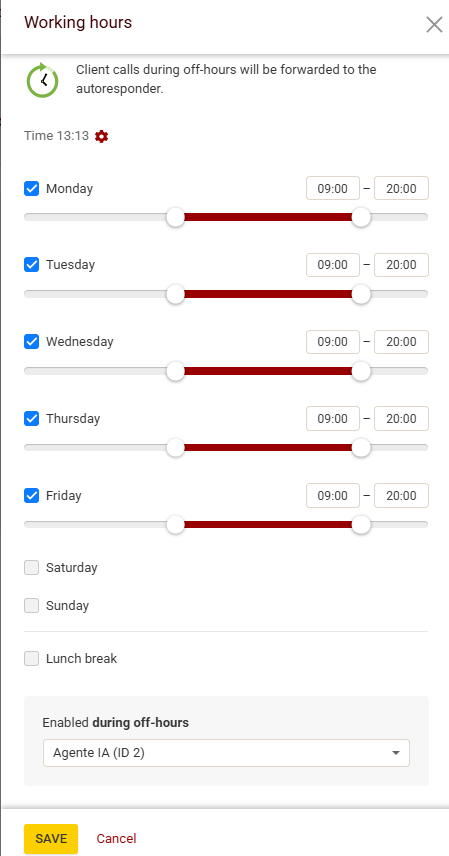
To check how the AI agent works outside opening hours, we set it up in the switchboard as the destination for incoming calls during the time slots when the clinic is closed, in the "My switchboard – Incoming calls and voice menu" section. Calls received outside business hours are automatically routed to the virtual agent, which can answer them without any staff being available.
During the tests, we verified that the agent responded in the configured language, maintained a friendly and professional tone, and gave information consistent with the data included in its knowledge base. We also verified that it identified itself at the start of the call as an AI virtual assistant and that the transfer took place according to the established rules. An important adjustment was to expressly include this identification in the opening greeting, so that the user knew from the very first moment that they were speaking with an artificial intelligence.
Where to start
The most practical approach is to start by identifying where the needs are, try a different distribution of calls and check whether it actually improves the service. To do this, you can follow these three steps as a summary of what we've covered:
- Record which calls you receive and when they occur.
For one week, analyze the volume by time slot, the reasons for inquiries and the most common languages. Also observe how many calls go unanswered and how long customers wait to be served. This will help you detect where you need more service capacity and which tasks you can delegate. - Decide which resource handles each call.
Once you've identified the needs, you can establish which inquiries the human team will continue to handle, which ones an external service can take on and which ones suit a virtual agent. Don't forget to define when a call should be transferred to a person and what information that person needs to receive in order to continue the conversation. - Review the results after one month and make the necessary adjustments.
Check whether missed calls have decreased, whether waiting times are shorter and whether customers manage to resolve their inquiries. Also review which questions the AI couldn't answer and whether it needs more information in its knowledge base.
You don't need to implement all the solutions at the same time. You can start with a simple combination, observe how it works and expand its use once you're clear on what it brings to your phone support.
To see how AI works in your business, you can try the Megacall AI agent. You just need to create an account to access the virtual switchboard, which includes the agent natively and lets you configure it according to your company's needs.
Frequently asked questions
What is a personalized phone support service?
It is a service that adapts the handling of each call to the characteristics and needs of the business. The person answering has information about the company, its services and its procedures, and can guide the customer, resolve their questions or transfer the call to the right person when necessary.
Can an AI provide personalized phone support?
Yes. To do so, it must be configured with information about the business, its role must be defined, and how it should respond to inquiries must be established. Aspects such as the greeting, the voice and the tone of the answers can also be customized, as well as the rules for transferring calls. Even so, inquiries that require judgment, negotiation or more specific attention can be passed on to a person.
Do I have to tell the customer they are being served by an AI?
Yes, unless it is obvious that they are interacting with an artificial intelligence system. Article 50 of the European AI Regulation establishes that people must be informed of this interaction clearly and from the first contact. This obligation applies from August 2, 2026.
What happens if the AI agent doesn't know how to answer a question?
It depends on the transfer rules that have been set. It can route the call to a human agent, transfer it to another support scenario or, if it isn't possible to resolve the inquiry at that moment, collect the customer's details so the team can contact them later.